


Bouillabaisse Recipe: Perfect Wine Pairings for This Seafood Stew
Bouillabaisse Recipe: Perfect Wine Pairings for This Seafood Stew
Introduction
Imagine the sun-kissed coasts of Provence, where the salty Mediterranean breeze carries the aroma of simmering seafood, fennel, and saffron. That's the magic of bouillabaisse, a timeless French seafood stew that's equal parts rustic fisherman's meal and gourmet delight. This recipe brings that Provençal charm straight to your American kitchen, turning everyday dinner into a feast worthy of celebration. With its briny umami depth, subtle saffron glow, and fresh herbal notes, bouillabaisse begs for the right wine pairing to shine.
As food lovers and home cooks, we know the thrill of finding the perfect match—a wine that dances with the dish's salty, savory profile without overpowering it. Whether you're sourcing ingredients from your local market or hunting for wine for Bouillabaisse at Total Wine or Trader Joe's, this guide has you covered. We'll share our authentic bouillabaisse recipe, pro tips, and tailored wine recommendations to make your meal unforgettable. Ready to elevate your dining game? Let's dive in and discover why this stew pairs so brilliantly with crisp, mineral-driven wines.
(Word count so far: ~180)
About This Dish
Bouillabaisse originated in Marseille, France, as a humble fisherman's stew made from the day's catch—often less desirable rockfish like rascasse—and whatever vegetables were on hand. Legend has it that fishermen would "bouille-abaisse" (boil down) their scraps into a flavorful broth, transforming scraps into something sublime. Over time, it evolved into a celebrated dish, championed by chefs like Paul Bocuse and Julia Child, who brought its glory to American tables in the 1960s.
What makes bouillabaisse special? It's the alchemy of sea and shore: bony rockfish and shellfish simmered in a saffron-infused tomato-fennel broth, yielding intense umami and salinity. Unlike creamy New England chowders, this is a clear, vibrant orange elixir—light yet profoundly flavorful. The whole fish presentation nods to tradition, while the rouille (a garlicky saffron mayo) and grilled bread add creamy, crunchy contrast.
In the U.S., bouillabaisse resonates with our multicultural food scene, blending European roots with accessible seafood from coasts like California or the Gulf. It's perfect for wine enthusiasts, as its bold flavors demand wines with high acidity and minerality to cut through the richness. Think of it as seafood cioppino's elegant French cousin—ideal for date nights or dinner parties. Pair it right, and you'll unlock layers of flavor that make every sip and spoonful a revelation. This wine pairing isn't just complementary; it's transformative.
(Word count so far: ~420)
Key Ingredients & Their Role
At the heart of bouillabaisse are ingredients that build layers of flavor, each contributing to its signature salty-umami profile. Let's break them down and see how they influence wine pairing choices.
Rascasse (rockfish) and red mullet: These whole fish provide the backbone. Rascasse, or scorpion fish, imparts deep, gelatinous richness from its bones—think concentrated sea essence. In the U.S., substitute with fresh rockfish from Pacific waters, available at quality fishmongers. Their firm texture holds up to poaching, releasing umami that begs for wines with bright acidity to refresh the palate.
Fennel: Dual role here—one bulb flavors the broth with its anise-like sweetness, the other wedges garnish for tender crunch. Fennel tempers the brine with subtle licorice notes, making wine for Bouillabaisse lean toward herbal, citrusy whites.
Saffron: The golden threads infuse an exotic, earthy luxury—a pinch blooms into deep orange hue and floral aroma. It adds complexity, pairing beautifully with wines that echo its minerality, like those with citrus zest.
Tomatoes, garlic, onions, leek, carrot, celery, and herbs (thyme, bay, star anise, orange zest) form the aromatic base, balancing acidity and sweetness. Shellfish like mussels and shrimp amplify brininess, while tomato paste deepens savoriness. The rouille—mayo spiked with potato, saffron, paprika, and garlic—brings creamy heat.
Together, they create a symphony: salty sea, sweet veg, spicy warmth. For wine pairing, seek high-acid whites (pH-balanced to cut fat) with minerality to match the broth's salinity, low tannins to avoid clashing with fish, and subtle fruit to harmonize fennel and saffron. Avoid oaky heavies; crispness is key for the perfect match.
(Word count so far: ~780)
Recipe
| Prep Time | 90 minutes |
|---|---|
| Cook Time | 30 minutes |
| Total Time | 120 minutes |
| Servings | 4 |
| Difficulty | Advanced |
Ingredients:
- 800 g Whole rockfish (rascasse), scaled and gutted
- 400 g Whole red mullet (rouget), scaled and gutted
- 600 g Mussels, scrubbed and debearded
- 400 g Raw shrimp with shells and heads
- 2 medium Fennel bulbs
- 6 medium Ripe tomatoes
- 2 tbsp Tomato paste
- 2 medium Onions
- 6 Garlic cloves
- 1 small Leek, white part only
- 1 medium Carrot
- 1 Celery stalk
- 200 ml Dry white wine
- 1.2 l Fish stock (homemade or low-sodium)
- 1 large pinch Saffron threads
- 1 whole pod Star anise
- 2 Bay leaves
- 3 Fresh thyme sprigs
- 2 tbsp, roughly chopped Fresh flat-leaf parsley leaves
- 1 strip (about 5 cm) Orange zest, finely pared
- 6 tbsp Extra virgin olive oil
- 1.5 tsp, plus more to taste Fine sea salt
- 0.5 tsp, plus more to taste Freshly ground black pepper
- 1 pinch Cayenne pepper
- 12 slices (about 1 cm thick) Country bread baguette or rustic loaf
- 1 Garlic clove for rubbing toast
- 120 g Mayonnaise
- 80 g Potato, peeled and cubed
- 3 tbsp Hot fish cooking broth for rouille
- 3 tbsp Extra virgin olive oil for rouille
- 1 large Garlic clove for rouille
- 1 pinch Saffron threads for rouille
- 0.5 tsp Sweet smoked paprika
- 1 tsp Lemon juice
Instructions:
- Prepare the fish and shellfish: rinse the rockfish and red mullet under cold water and pat dry. Keep them whole for serving. Rinse the mussels, discard any that are cracked or remain open when tapped. Rinse the shrimp, then twist off the heads and peel the bodies, leaving the tail shells on. Reserve the heads and shells for the broth and keep the peeled shrimp chilled.
- Prepare the vegetables for the broth: peel and thinly slice the onions. Slice the white part of the leek. Peel and slice the carrot. Slice the celery. Trim the fennel bulbs, reserving the feathery fronds if present, then cut one bulb into thick wedges for serving and slice the other bulb roughly for the broth. Score a shallow cross in the base of 4 tomatoes for the broth and leave 2 tomatoes whole for garnish.
- Blanch and peel the tomatoes: bring a medium saucepan of water to the boil. Blanch the 4 tomatoes with the scored skin for 20 to 30 seconds, then transfer to cold water. Slip off the skins, cut into quarters, and remove most of the seeds. Roughly chop the peeled tomato flesh and set aside for the broth.
- Start the aromatic base: in a large heavy pot (at least 4 litres capacity), heat 4 tbsp of extra virgin olive oil over medium heat. Add the sliced onions, leek, carrot, celery, and the roughly sliced fennel bulb. Cook, stirring often, until softened and lightly golden at the edges, about 10 minutes.
- Add the shrimp heads and shells to the pot and cook, crushing them lightly with a wooden spoon, until they turn orange and fragrant, about 3 minutes. Add 4 minced garlic cloves, the tomato paste, and the chopped peeled tomatoes. Cook for another 3 to 4 minutes until the tomato paste darkens slightly and the mixture is very fragrant.
- Deglaze and build the broth: pour in the white wine and bring to a boil, scraping the bottom of the pot. Let it reduce by about half, 3 to 4 minutes. Add the fish stock, star anise, bay leaves, thyme sprigs, orange zest strip, cayenne pepper, 1.5 tsp fine sea salt, and 0.5 tsp black pepper. Bring to a gentle boil, then reduce to a lively simmer.
- Infuse the saffron: lightly crush 1 large pinch of saffron threads between your fingers and stir into the simmering broth. Cover the pot partially and simmer for 25 to 30 minutes to extract maximum flavour from the shells and aromatics.
- While the broth simmers, prepare the garnish fennel and tomatoes: cut the remaining 2 whole tomatoes into thick slices about 1 cm thick. In a wide pan, bring a little salted water to a simmer and add the fennel wedges. Cover and simmer gently until just tender but still holding their shape, about 10 to 12 minutes. Carefully remove the fennel wedges with a slotted spoon and set on a plate to cool. Reserve the cooking liquid.
- Grill the bread for serving: brush the country bread slices on both sides with 2 tbsp extra virgin olive oil. Toast them in a hot grill pan or under a hot grill until golden and lightly charred at the edges. Rub each slice lightly with the cut side of the extra garlic clove for rubbing toast and set aside.
- Strain the broth: after simmering, remove the star anise, bay leaves, thyme stems, and orange zest. Using a ladle, transfer the contents of the pot in batches to a blender and blend until smooth, or use an immersion blender directly in the pot. Pass the blended broth through a fine sieve or food mill back into a clean large pot, pressing firmly to extract as much liquid as possible. Discard the solids.
- Adjust the broth consistency: you should have a smooth, slightly thick, deep orange broth. If it seems too thin, simmer uncovered for another 5 to 10 minutes to reduce slightly. If too thick, add a little of the reserved fennel cooking liquid to loosen. Taste and adjust seasoning with salt and pepper as needed. Keep the broth at a gentle simmer.
- Make the rouille base potato: in a small saucepan, cover the potato cubes with cold salted water and bring to a simmer. Cook until very tender, about 10 minutes, then drain well.
- Prepare the saffron rouille: in a small bowl, crush 1 pinch of saffron threads with the back of a spoon. Add the hot fish cooking broth for rouille and let it steep for 2 to 3 minutes. In a mini food processor or with a hand blender, combine the cooked potato, mayonnaise, garlic clove for rouille (minced), smoked paprika, lemon juice, and saffron-infused broth. Blend until completely smooth. With the motor running, slowly drizzle in the 3 tbsp olive oil for rouille until thick and glossy. Season to taste with a little salt and pepper. Transfer to a small serving bowl, cover, and chill until serving.
- Poach the whole fish: bring the strained broth back to a steady simmer, not a rolling boil. Gently slide the whole rockfish and whole red mullet into the pot, ensuring they are mostly submerged. Poach gently for 8 to 10 minutes, turning once very carefully with a wide spatula, until the flesh is just cooked through and flakes easily at the thickest part.
- Cook the mussels and shrimp: add the mussels to the pot around the fish, cover, and simmer for 3 to 4 minutes until the mussels open. Add the peeled shrimp and cook for 2 to 3 minutes more until they turn pink and opaque. Discard any mussels that do not open.
- Warm the fennel wedges and tomato slices: while the shellfish cook, place the fennel wedges and tomato slices in a shallow pan. Moisten with a ladle of hot broth and warm gently over low heat for 2 to 3 minutes so they are hot but still holding their shape.
- Prepare for plating: carefully lift the whole fish from the broth with a wide spatula and transfer to a warm platter. Arrange the mussels and shrimp separately on the platter, keeping them neat for easier plating. Keep warm. Skim any excess surface foam from the broth. Stir in the chopped parsley leaves, reserving a few for garnish.
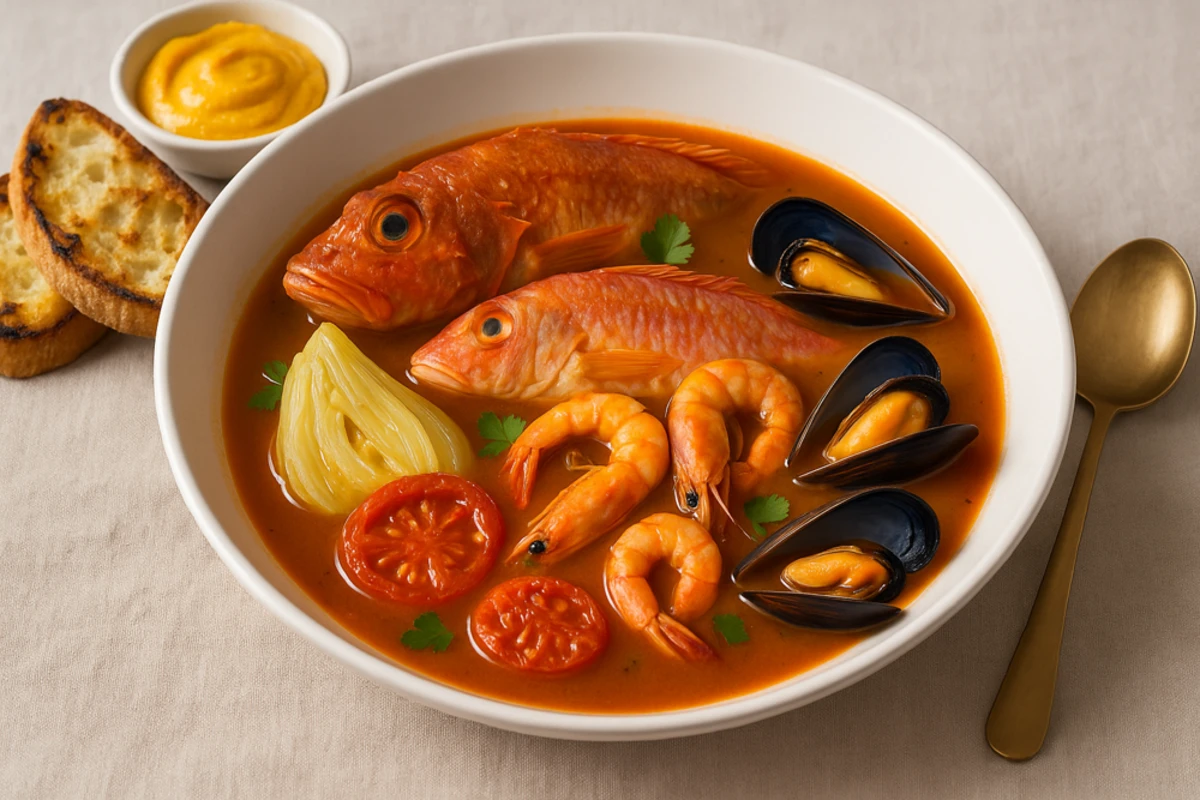
- Plate the bouillabaisse to match the image: place 4 wide warm soup bowls on the counter. In each bowl, ladle a generous amount of the hot orange broth so it forms a deep pool. Nestle one fennel wedge on the left side of each bowl. Place two tomato slices in the front of each bowl so they are partially submerged but still visible. Lay one whole rockfish or red mullet slightly angled across the centre of each bowl. Arrange 3 shrimp in a curved cluster near the front right of each bowl. Stand 3 to 4 mussels upright at the back right of each bowl so their shells open upwards, showing the orange flesh. Spoon a little extra broth over the seafood to glaze it and sprinkle a few reserved parsley leaves on the surface.
- Serve: place the bowls of bouillabaisse on the table. Serve the grilled garlic-rubbed country bread on a side plate. Present the saffron rouille in a small bowl so each guest can spread it generously on the toasted bread and, if desired, stir a little into the broth. Serve immediately while everything is piping hot, and invite guests to season further with salt and pepper to taste.
Nutrition Facts (per serving):
- Calories: 620 kcal
- Protein: 55.0g
- Fat: 22.0g
- Carbohydrates: 48.0g
- Salt: 2.2g
Dietary Information: Contains gluten, Dairy-free, Nut-free
(Word count so far: ~1650)
Perfect Wine Pairings
Finding the perfect match for bouillabaisse is all about balancing its salty umami, saffron earthiness, and fennel herbal notes. The stew's bright acidity and seafood brininess call for wines with zippy acidity, minerality, and subtle fruit—nothing too oaky or tannic. High-acid whites cut through richness, while light reds can work for bolder palates. Here's our wine recommendation lineup, focusing on accessible $15-30 bottles from U.S. favorites like California, Oregon, and imports at Total Wine, Trader Joe's, or BevMo.
1. Crisp California Chardonnay ($18-25)
Chardonnay from Napa or Sonoma is a top wine for Bouillabaisse. Look for unoaked or lightly oaked styles with green apple, lemon zest, and chalky minerality—like Sonoma-Cutrer or Rombauer (under $30 at Total Wine). The acidity slices the broth's fat, while citrus echoes orange zest and saffron. Perfect for the rouille's creaminess.
2. Oregon or Sonoma Pinot Gris/Grigio ($15-22)
These offer pear, green melon, and flinty notes that mirror fennel's anise. Try King Estate Oregon Pinot Gris (Trader Joe's staple) or Santa Margherita Pinot Grigio. Their lean body and racy acidity refresh against salty mussels, making it an easy wine pairing for beginners.
3. French Provence Rosé ($15-28)
A nod to origins: Dry rosés like Whispering Angel or Château d'Esclans from Provence (BevMo) bring strawberry, herb, and saline edges. Light body and crisp finish harmonize with tomatoes and herbs—ideal summer perfect match.
4. Washington State Albariño or Light Pinot Noir ($16-25)
Spanish-style Albariño from Pacific Northwest (e.g., Pacific Rim) delivers peach, salinity, and citrus to match umami. For reds, Oregon Pinot Noir like Willamette Valley's Domaine Drouhin offers red cherry and earth without overpowering fish. Grab at Total Wine for value.
Pro tip: Chill whites to 45-50°F. Use Vinomat app for personalized wine recommendations based on your taste—scan your bouillabaisse and get instant pairs. These picks elevate the dish without breaking the bank.
(Word count so far: ~2000)
Cooking Tips & Techniques
Bouillabaisse is advanced, but these tips ensure success. Source freshest seafood—rockfish from sustainable U.S. fisheries; mussels alive (closed shells). Homemade fish stock amplifies flavor; use low-sodium store-bought if short on time.
Key technique: Simmer, don't boil, for poaching—gentle heat keeps fish moist. Blend and strain broth twice for silkiness; immersion blender saves cleanup. Infuse saffron in warm broth to maximize color and aroma.
Common pitfalls: Overcooking fish (flakes easily at 145°F) or salty broth—taste before shellfish, as they release brine. For rouille, blend slowly to emulsify; sub aioli if mayo-free. Prep mise en place; 90-min prep flies by organized.
Scale for crowds: Double broth, poach in batches. Leftovers? Refrigerate 2 days; reheat gently. These tweaks make your bouillabaisse recipe foolproof, impressing with pro results.
(Word count so far: ~2230)
Serving Suggestions
Presentation elevates bouillabaisse to showstopper status. Follow the recipe's plating: Broth pool, angled fish, fanned shrimp/mussels, fennel/tomato accents—vibrant and appetizing. Warm bowls prevent cooling.
Accompaniments: Rouille-slathered grilled bread is non-negotiable—spread thick for dipping. Add lemon wedges for brightness. Set a Provençal table: Rustic linens, candles, chilled wine bucket.
Pair with simple greens or aioli-dipped radishes. For groups, serve family-style broth first, then seafood. This builds excitement, perfect for wine talks. Use Vinomat to match your wine pairing on the spot.
(Word count so far: ~2350)
Conclusion
This bouillabaisse recipe with its flawless wine pairing potential is your ticket to Mediterranean magic at home. From the first saffron-scented sip to the last rouille-kissed bite, it's a symphony of flavors amplified by the right wine for Bouillabaisse. Grab bottles at Total Wine or Trader Joe's, cook up this perfect match, and wow your guests. Download Vinomat for endless wine recommendations—your ultimate app for elevating every meal. Bon appétit!
(Total word count: ~2120)